

Skin Cancer
Actinic Keratosis: Warning Signs You Shouldn't Ignore
TL;DR: Actinic keratosis is a rough, scaly, precancerous spot caused by years of UV exposure, most often on the face, scalp, ears, and hands. A small percentage can progress to squamous cell carcinoma, so early evaluation matters. Common treatments include cryotherapy, topical creams (5-FU, imiquimod), photodynamic therapy, and curettage.
Years of ultraviolet (UV) exposure can leave more than freckles behind. A persistent rough or scaly patch may be an actinic keratosis (AK), a precancerous growth that deserves professional evaluation. Recognizing the warning signs early can help you seek care before a concerning spot changes. Dr. Parth Patel and PS Dermatology provide actinic keratosis treatment in Bridgewater, NJ.
What Is Actinic Keratosis, and Why Should You Pay Attention?
Actinic keratosis (AK), also called solar keratosis, is a precancerous skin growth caused by cumulative UV damage from sunlight or indoor tanning. Some AKs can develop into squamous cell carcinoma, but clinicians cannot reliably predict which individual lesion will progress. That uncertainty is why dermatologic evaluation and treatment are commonly recommended.
These lesions cluster on the skin that logs the most sun: the forehead and balding scalp, the tops of the ears, the lower lip, the neck, the forearms, and the backs of the hands. Because they are often only a millimeter or two thick, most patients feel the sandpapery texture with a fingertip before they ever spot one in the mirror. It feels like dry skin but it isn’t dry skin.
AKs are treatable, but the best approach depends on the number, thickness, and location of the growths and the extent of surrounding sun damage. Some treatments are completed in the office, while others require medication applied at home over days or weeks. If a rough patch is new, persistent, or repeatedly flakes and returns, have a dermatologist examine it rather than picking or treating it on your own.
What Does Actinic Keratosis Look Like? (Symptoms & Warning Signs)
Actinic keratosis usually appears as a small, rough, scaly patch that feels like sandpaper on sun-exposed skin. The actinic keratosis symptoms are often easier to feel than to see, which is why so many go unnoticed for months.
Textures and colors to watch for
These sun damage skin lesions can vary in appearance, but common features include:
- A dry, rough, or gritty texture, like fine sandpaper
- Colors ranging from skin-toned to pink, red, or brownish
- A raised, crusty, or wart-like surface
- Occasional itching, burning, or tenderness
Where these spots show up most
Look closely at the areas that catch the most sun: the forehead, cheeks, nose, ears, lips, balding scalp, forearms, and the backs of the hands. In our Central NJ community, especially in Somerset, Hunterdon, Middlesex county, these are the same spots that go unprotected during long days outdoors.
Symptoms that warrant a closer look
Some warning signs deserve prompt attention, including a spot that bleeds, grows quickly, becomes painful, thickens, or refuses to heal. If you notice any of these, talk with your provider about an evaluation rather than waiting to see if it resolves on its own.
Actinic Keratosis vs. Seborrheic Keratosis: How Do You Tell Them Apart?
Actinic keratosis is a precancerous lesion tied to sun damage, while seborrheic keratosis is a harmless, waxy growth that carries no cancer risk. Telling these two apart matters because one needs monitoring and the other typically does not.
Seborrheic keratoses often look like they were pressed or "stuck on" the skin and can appear almost anywhere, including areas rarely exposed to sun. Actinic keratoses, by contrast, live on chronically sun-exposed skin and feel gritty rather than waxy.
| Feature | Actinic Keratosis | Seborrheic Keratosis |
|---|---|---|
| Cancer risk | Precancerous; evaluation and treatment are often recommended | Benign, though a new or changing growth may still need evaluation |
| Texture | Rough, scaly, sandpaper-like | Waxy, "stuck-on" |
| Cause | Cumulative UV exposure | Not linked to sun damage |
| Location | Sun-exposed skin | Anywhere on the body |
Because appearances can overlap, a board-certified dermatologist such as Dr. Parth Patel, is the best resource for an accurate distinction. When in doubt, have it checked.
What Causes These Precancerous Skin Spots?
Cumulative UV exposure from the sun and tanning beds is the primary cause of these precancerous skin spots, which is why they are classified as sun damage skin lesions. Years of unprotected exposure add up, damaging skin cells over time.
Certain factors raise the likelihood of developing actinic keratosis and sun spots:
- Fair skin, light eyes, and skin that burns easily
- Age over 40, as damage accumulates across decades
- A history of frequent sunburns or tanning bed use
- Outdoor lifestyles common across Somerset, Hunterdon, and Middlesex counties
- A weakened immune system
Weekend gardeners, golfers, and cyclists throughout Central NJ near Bridgewater, Flemington, Hillsborough, Warren or Branchburg often accumulate significant sun exposure without realizing it. Understanding your personal risk factors can help you and your provider decide how closely to monitor your skin.
Can Actinic Keratosis Turn Into Skin Cancer If Left Untreated?
Yes, a portion of untreated actinic keratosis lesions can progress to squamous cell carcinoma over time, though many remain stable or even resolve. The squamous cell carcinoma risk is why dermatologists favor monitoring and early treatment over a wait-and-see approach.
The American Academy of Dermatology explains that some AKs and actinic cheilitis can become squamous cell carcinoma. Because there is no reliable way to know which individual AK will progress, treatment is often recommended after diagnosis.
Actinic keratosis is not the only sun-related concern; other common skin cancers include basal cell carcinoma, which is highly treatable when caught early. Timelines for progression vary widely, sometimes years, which is exactly why regular skin checks matter. If a spot changes, discuss it with your dermatologist promptly.
How Is Actinic Keratosis Diagnosed by a Dermatologist?
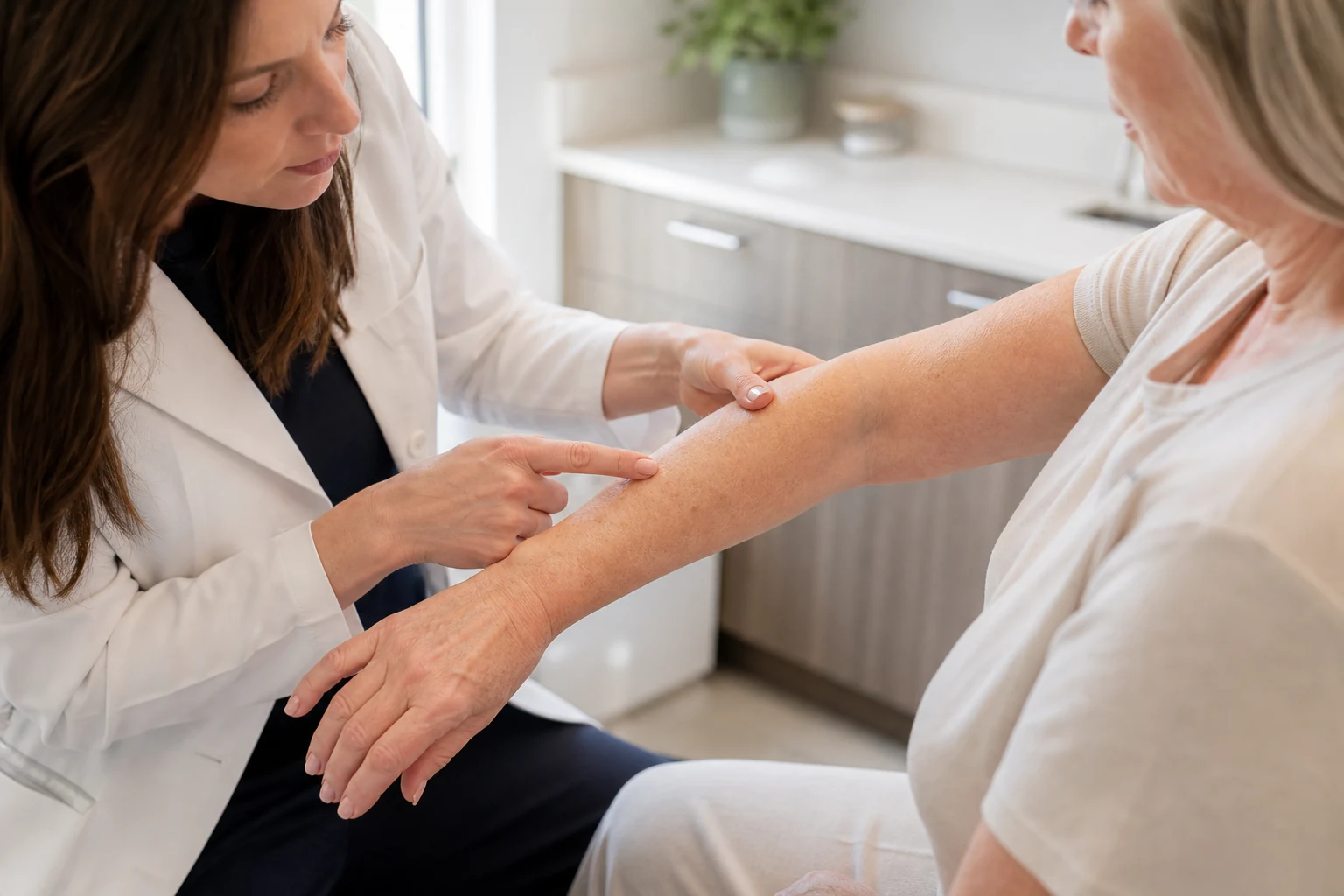
A board-certified dermatologist such as Dr. Parth Patel typically diagnoses actinic keratosis through a visual and tactile skin exam, running gloved fingers over suspicious areas to feel their characteristic rough texture. Most cases are identified this way, without any additional testing.
During a diagnostic skin exam, your provider examines sun-exposed areas closely, notes the size and texture of any lesions, and reviews your sun exposure history. Sometimes a dermatoscope, a specialized magnifying tool, is used for a closer view.
If a lesion looks unusually thick, bleeds, or has features that could suggest cancer, your dermatologist may recommend a skin biopsy to confirm the diagnosis before treatment. This is a simple in-office step that removes a small sample for laboratory analysis. Whether or not you need a biopsy first is a decision your provider will make based on how each spot appears.
What Are Your Treatment Options for Actinic Keratosis in Bridgewater, NJ?
Actinic keratosis treatment may include prescription topical medication or an in-office procedure such as cryotherapy, photodynamic therapy, curettage, laser therapy or chemical peels. The right approach depends on how many AKs are present, where they appear, what they look like, your medical history, and whether you have previously had skin cancer. The American Academy of Dermatology outlines these clinician-directed options.
Prescription topical treatment (5-FU)
Topical treatments such as 5-fluorouracil (5-FU) are creams applied over several days, often preferred when multiple spots cover a broad area. Some patients experience redness, peeling, or irritation during treatment, which your provider can help you manage. Follow application instructions closely and check in with your dermatologist about side effects.
In-office cryotherapy, PDT, and curettage
In-office options work well for isolated or stubborn lesions:
- Cryotherapy: freezing the spot with liquid nitrogen
- Photodynamic therapy (PDT): a light-activated solution that targets damaged cells across an area
- Curettage: gently scraping away the lesion, sometimes paired with cautery
These treatments should be selected and performed or prescribed by a qualified clinician. Do not freeze, scrape, or apply prescription medication to a suspected AK without first confirming the diagnosis.
Cryotherapy vs. photodynamic therapy: which is better?
Neither is universally best. Cryotherapy is often considered ideal for a few discrete spots, while PDT can address multiple lesions across a larger sun-damaged field in one session. Your provider will recommend based on your specific situation.
When Mohs surgery enters the picture
Actinic keratosis itself does not require Mohs surgery. However, if a lesion has already progressed to squamous cell carcinoma, our Mohs surgery specialty allows for precise, tissue-sparing removal. Talk with your Dr. Parth Patel about which path fits your diagnosis. He is a top recognized leader in skin cancer treatment in Central New Jersey.
Recovery, Aftercare, Cost, and Insurance: What Should You Expect?
Actinic keratosis treatment is usually outpatient, but recovery varies considerably. A treated spot may heal over days or weeks, while field treatment with prescription medication can cause a visible reaction for several weeks. Your dermatologist should explain the expected timeline, wound care, sun precautions, and signs that warrant a call.
Aftercare by treatment type
- Cryotherapy: the frozen spot often blisters or scabs within a day and sheds over one to two weeks, sometimes leaving a temporarily lighter patch of skin
- Prescription topical medication: redness, crusting, peeling, or tenderness can occur. The schedule varies by medication. Follow the exact instructions from your prescriber and contact the office if the reaction is more severe than expected.
- Curettage: keep the small wound clean and covered; it usually closes within one to two weeks and may leave a faint mark
Protect the treated area from sun during healing and follow your clinician's aftercare instructions closely. Call the office if you develop worsening pain, spreading redness, pus, fever, or another reaction that concerns you.
How Can You Protect Your Skin and Prevent New Spots?
Daily broad-spectrum SPF, protective clothing, and routine skin checks are the most effective ways to prevent new actinic keratosis and catch recurrence early. Prevention is where you have the most control.
Everyday sun protection habits
Simple, consistent habits make a real difference for Bridgewater and Central NJ residents:
- Apply broad-spectrum SPF 30 or higher daily, reapplying every two hours outdoors
- Wear wide-brimmed hats, UPF clothing, and sunglasses
- Seek shade during peak midday hours at parks and ballfields
- Avoid tanning beds entirely
If you have ever wondered does sunscreen prevent skin cancer, consistent daily use is one of the most evidence-supported protective steps you can take.
Why ongoing monitoring matters
Actinic keratosis can recur, so periodic professional exams and a monthly skin self-exam help you spot changes early. A trusted local dermatologist who knows your skin history is a valuable partner in long-term monitoring.
Talk With Our Team
Rough, scaly patches that will not go away are worth a professional look, and early attention keeps actinic keratosis highly manageable. As a dermatology and dermatologic surgery practice with a Mohs surgery specialty, PS Dermatology and Surgery in Bridgewater, NJ is here to evaluate your skin, explain your options, and build a plan that fits you. If you would like to understand your options, our team is happy to talk it through.
This article is for general education and is not a substitute for diagnosis or individualized medical advice.
Sources
- American Academy of Dermatology: Actinic Keratosis Overview
- American Academy of Dermatology: Actinic Keratosis Diagnosis and Treatment
- National Cancer Institute: Skin Cancer Treatment
Frequently Asked Questions
What are the warning signs of actinic keratosis you shouldn't ignore?
Watch for rough, scaly, or sandpapery patches that feel dry to the touch, often on sun-exposed skin. Warning signs may include spots that are new, persistent, flaking, or that return after being scratched off. If a rough patch keeps coming back, talk to your doctor for evaluation.
Where does actinic keratosis usually appear on the body?
Actinic keratosis typically clusters on skin that receives the most sun exposure over the years. Common locations include the forehead, balding scalp, tops of the ears, lower lip, neck, forearms, and the backs of the hands. Because lesions are thin, many people feel them before seeing them.
Can actinic keratosis turn into skin cancer?
Actinic keratosis is considered precancerous and may progress to squamous cell carcinoma if left untreated. It represents the earliest visible sign that sun-damaged cells have begun growing abnormally. Because of this risk, dermatologists often recommend treating lesions early rather than monitoring them indefinitely. Consult a board-certified dermatologist for guidance.
Why should actinic keratosis be treated instead of watched?
Treatment is often recommended because actinic keratosis sits one step away from squamous cell carcinoma. Catching and treating lesions early, frequently in a single outpatient visit, may clear them before they have a chance to advance. Early intervention can rewrite the outcome, so discuss options with your dermatologist.
How is actinic keratosis diagnosed?
Actinic keratosis is usually diagnosed by a board-certified dermatologist through a physical skin examination, often using touch to detect the sandpapery texture. In some cases, a skin biopsy may be performed to confirm the diagnosis and rule out skin cancer. Talk to your provider about a thorough skin evaluation.
What causes actinic keratosis to develop?
Actinic keratosis develops after years of cumulative ultraviolet exposure that reprograms the outermost layer of your skin. Decades of time spent outdoors, whether hiking or watching outdoor sports, can contribute. People with fair skin and significant sun history may face higher risk, so regular skin checks are worthwhile.
How is actinic keratosis treated in Bridgewater, NJ?
Actinic keratosis is frequently treated during an outpatient visit, often in a single appointment. Approaches may include cryotherapy, topical medications, or other in-office procedures depending on the lesions. At PS Dermatology and Surgery in Bridgewater, NJ, a board-certified dermatologist such as Dr. Parth Patel, can recommend the option best suited to your skin.
Ready to talk with a dermatologist?
Schedule a visit with our team at PS Dermatology and Surgery in Bridgewater, NJ - serving patients throughout Central New Jersey.