
What is Lichen Planus?
Lichen planus is a chronic inflammatory condition that affects both the skin and mucosal surfaces. The nails and scalp can also be involved. Although it has been linked with several other disorders, its precise cause is unknown.
The disorder affects about one in one hundred people around the world, and is most common in adults over age 30. It is very rare in children. In about 10% of cases, a significant family history has been noted, making it one of the predisposing factors of the disease. In approximately 3% of patients, the lesions on the mucosa can transform into squamous cell carcinoma. Some cases of lichen planus affect the scalp or nails only.
What Causes Lichen Planus?
The exact cause of lichen planus remains unknown or idiopathic. Besides its link with family history, certain drugs also seem to trigger the condition. Among them: anxiolytic drugs, antipsychotics, gold, anti-malaria drugs, quinidine, thiazide diuretics, and angiotensin-converting-enzyme inhibitors. Lichen planus has also been noted more often in people with various autoimmune diseases, e.g. vitiligo, systemic lupus erythematosus, conditions of the thyroid gland, and inflammatory bowel disease.
Signs & Symptoms of Lichen Planus
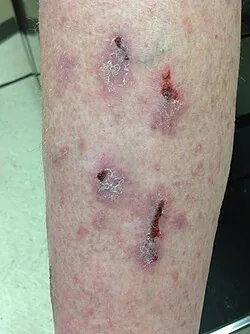
The primary lesion in lichen planus is a polygonal, flat-topped, purple papule with so-called Wickham's striae on its surface — fine white lines that become visible in contact with mineral oil. The lesions are most commonly located on the flexor surfaces of the wrists, forearms, ankles, and groin, as well as in places of previous mechanical injury (Koebner's sign). Itching and discomfort are characteristic of the condition. Mucosa are also very frequently affected, especially in the oral cavity. There, typical white tree-shaped, branched lesions can be seen. When lichen planus affects the nails, they usually get covered with characteristic linear grooves. The nail may also darken, thicken, or be completely lifted off the nail bed — a condition called onycholysis. With time, the lesions on the skin thicken and become hypertrophic due to excessive cell proliferation. Many times, the lesions will leave dark marks called "hyperpigmentation" behind. Sometimes the rash spontaneously disappears on its own after 1–2 years, however, therapy is often required to control the symptoms. On the scalp, lichen planus can cause hair loss both diffusely and in a band across the front of the hairline and eyebrows (Frontal Fibrosing Alopecia).
Lichen Planus Treatment Options
Pharmacological Therapy
Pharmacological therapy is an effective option in the treatment of lichen planus. First-choice treatment is high-potency topical steroids — e.g. clobetasol (Clobex®), mometasone (Elocon®), or fluocinonide (Lidemol®). Triamcinolone (Kenalog®) injections are an effective method of treating thickened or picked areas. Second-choice pharmacological treatment is topical tacrolimus (Protopic®). For bothersome itching, oral antihistamines (hydroxyzine, loratadine) are often prescribed. In more severe or resistant cases, oral prednisone, acitretin, azathioprine, cyclosporine, or hydroxychloroquine are to be considered. PS Dermatology & Surgery will determine the most suitable therapy in your individual case to address your concerns.
Phototherapy
Phototherapy is a very effective option in the treatment of lichen planus. It is well-tolerated, non-invasive, and can be safely repeated. During a session, narrowband UVB light is used. This refers to a specific type of ultraviolet light, with a particular wavelength of 311–312 nm. Studies have shown that this kind of radiation provides the best results in clearing various skin conditions. It has also been proven safe with respect to skin cancer — there is no proof that phototherapy increases the risk of this disease. In most cases, a common treatment plan is 2–3 treatments a week over several weeks, and PS Dermatology & Surgery will personalize your therapy parameters for the best possible effects.