
Understanding Acne Scars
Acne vulgaris, commonly referred to as acne, is a widespread skin condition affecting individuals of all ages. While acne itself is often treatable, it can leave behind blemishes in the form of scars. These scars can be a source of aesthetic concern for many patients.
Types of Acne Scars: Classification
Acne scars can be broadly categorized into Atrophic Scars and Hypertrophic/Keloidal Scars.
Atrophic Acne Scars (Depressed)
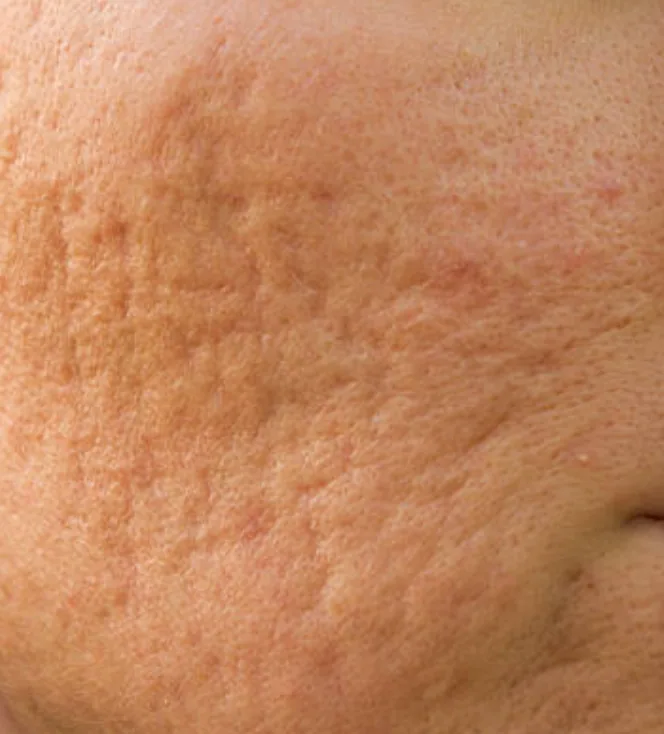
Atrophic scars are depressed or pitted scars that develop due to a loss of underlying tissue. They are the most prevalent type of acne scar and can be further subclassified into three distinct subtypes:
Ice Pick Scars
Narrow, deep, and V-shaped with sharp edges.
Boxcar Scars
Wider than ice pick scars, with well-defined margins and a rounded or oval shape.
Rolling Scars
Uneven depressions with sloping edges that may partially smooth out when the skin is stretched.
Hypertrophic and Keloid Scars (Raised)
Hypertrophic/Keloid scars are raised scars that result from an overproduction of collagen during the wound healing process. Keloid scars are a more severe form, extending beyond the original boundaries of the healed acne lesion.
Treatment Options for Acne Scars
The optimal treatment strategy for acne scars depends on several factors, including the type, severity, and individual characteristics of the patient's skin. Dr. Parth Patel can conduct a thorough evaluation to determine the most suitable approach. Here's a summary of common treatment modalities:
Superficial or medium-depth peels remove the outermost layers of skin, promoting new cell growth and improving the appearance of shallower scars.
Dermabrasion
A more ablative technique than chemical peels - physical removal of the uppermost layer of skin.
Laser Therapy
CO2 Ablative Lasers and Fraxel® Non-Ablative Lasers stimulate collagen production for fresh, healthier skin.
Subcision
A minor surgical procedure using a needle-like tool to treat depressed cutaneous scars and wrinkles.
Injectable fillers can be strategically placed to elevate depressed scars and create a smoother skin surface.
Corticosteroid Injections
Direct injection of corticosteroids into hypertrophic/keloidal scar tissue can help soften and flatten raised scars.
Surgical Excision
In some cases, surgical removal of the scar tissue might be an option.