
What is Pityriasis Rosea?
Pityriasis rosea is a common, self-limiting skin disorder that mostly affects the chest, back, and proximal extremities. Its cause, although associated with herpesviruses HHV-6 and HHV-7, still remains partially unknown.
The condition is more common in women than in men and usually appears in young adults between 15 and 35 years old, with a peak age of about 23. The lesions often show shortly after an episode of symptoms typical of a viral upper respiratory tract infection (dry cough, cold, sore throat, runny nose). No specific predisposing factors have been noted.
What Causes Pityriasis Rosea?
The cause of pityriasis rosea is not completely known. It is linked to a reactivation of herpesviruses 6 and 7, the same pathogens responsible for roseola or the sixth disease in infants. Similar rashes have been observed as an adverse reaction to certain medicines, for example angiotensin-converting enzyme inhibitors, nonsteroidal anti-inflammatory drugs, hydrochlorothiazide, atypical antipsychotics, isotretinoin, or metronidazole.
Signs and Symptoms
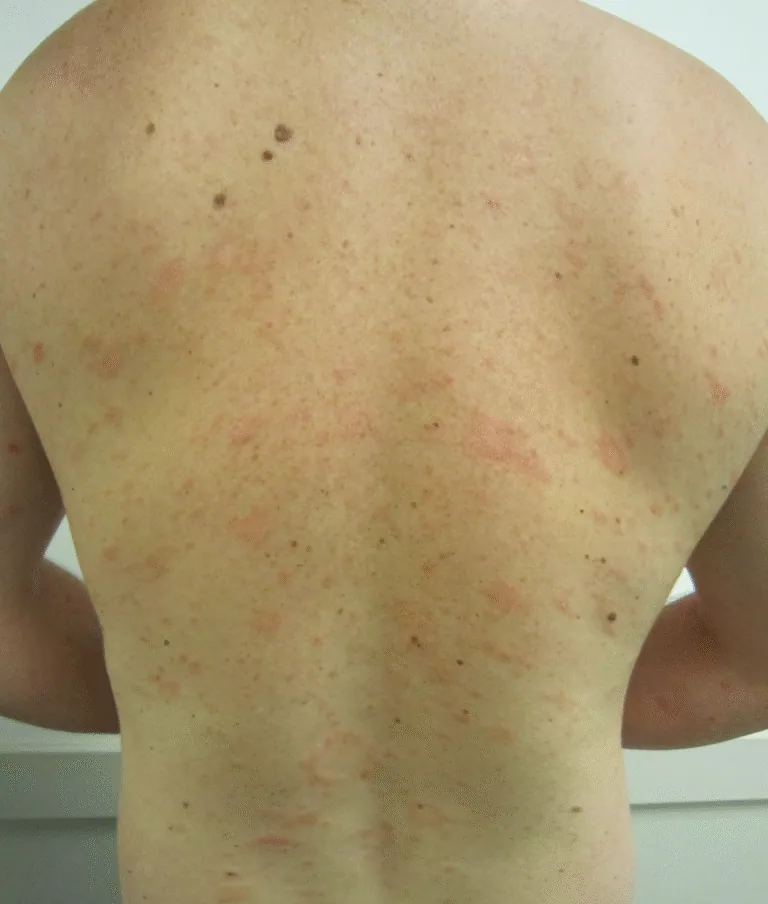
The disorder has a typical clinical course with characteristic stages. First, after an upper respiratory tract infection, a single so-called "herald patch" or "plaque mère" appears, often on the torso. It is the biggest lesion in the course of the disease, oval-shaped, pinkish on the outside and skin-colored in its center, with peripheral scaling and peeling. It heralds a more extensive, secondary rash on the chest, back, and proximal extremities that usually shows 1-20 days afterwards and often follows the pattern of a "christmas tree".
The subsequent lesions are abundant yet smaller, in the form of scaly, well-defined, pinkish patches or plaques. Similar to the plaque mère, the scaling or peeling tends to take place at the periphery of the lesion. The rash can itch or not at all. It is self-limiting and lasts for about 4-6 weeks; however, around 2% of patients are prone to relapses that go on from months to years. Systemic symptoms like fever or chills are not present.
Treatment Options
General Daily Measures
- Avoid regular soap. Gentle, dermatologically tested cleansers and oils with plain, lukewarm water will suffice.
- Moisturize the skin with dermatologically tested products.
- Be cautious when exposing the skin to excess sun.
Pharmacological Therapy
Since pityriasis rosea is a self-limiting condition, in most cases no pharmacological treatment is necessary. If symptoms happen to be particularly bothersome, a doctor might prescribe some medication. Among topical therapies, steroids from group V (hydrocortisone, fluticasone propionate) as well as menthol solutions are applied.
For oral treatments, a 2-week erythromycin (Erythrocin®) course seems to be helpful because of the drug's anti-inflammatory benefits. In cases of intense itching, oral antihistamines (fexofenadine, loratadine) can be prescribed. Sometimes, oral antiviral medications such as valacyclovir are used as well to target the causative virus. When the rash is unusually extensive, a short course of prednisone is used. PS Dermatology & Surgery will choose the best pharmacological treatment in your individual case.