
Medical Dermatology
Psoriasis or Eczema? How to Tell the Difference
Red, itchy, flaky patches can come from more than one skin condition, and the two most often mixed up are psoriasis and eczema. They can look alike, they both tend to flare in dry winter air, and over-the-counter creams do not reliably settle either one. The difference matters, because each is treated in its own way.
What is the main difference between psoriasis and eczema?
The short answer is what drives each one. Psoriasis is an immune-driven condition in which skin cells are produced much faster than normal, so they build up into thick layers before they have time to mature. Eczema, also called atopic dermatitis, is an itchy inflammatory condition in which the skin barrier does not hold moisture well and reacts strongly to irritants and allergens.
That difference in cause is why the two look and feel different on the skin, and why a treatment that helps one may do little for the other.
How do they look and feel different?
There is overlap, but a few patterns help tell them apart.
| Eczema (atopic dermatitis) | Psoriasis | |
|---|---|---|
| How it feels | Itch is usually the main symptom, and it often starts before the rash | Can itch, burn or sting, though itch is often milder |
| How it looks | Dry, rough, red or darker patches that may ooze or crust when scratched | Thick, raised plaques with clear edges and a silvery-white scale |
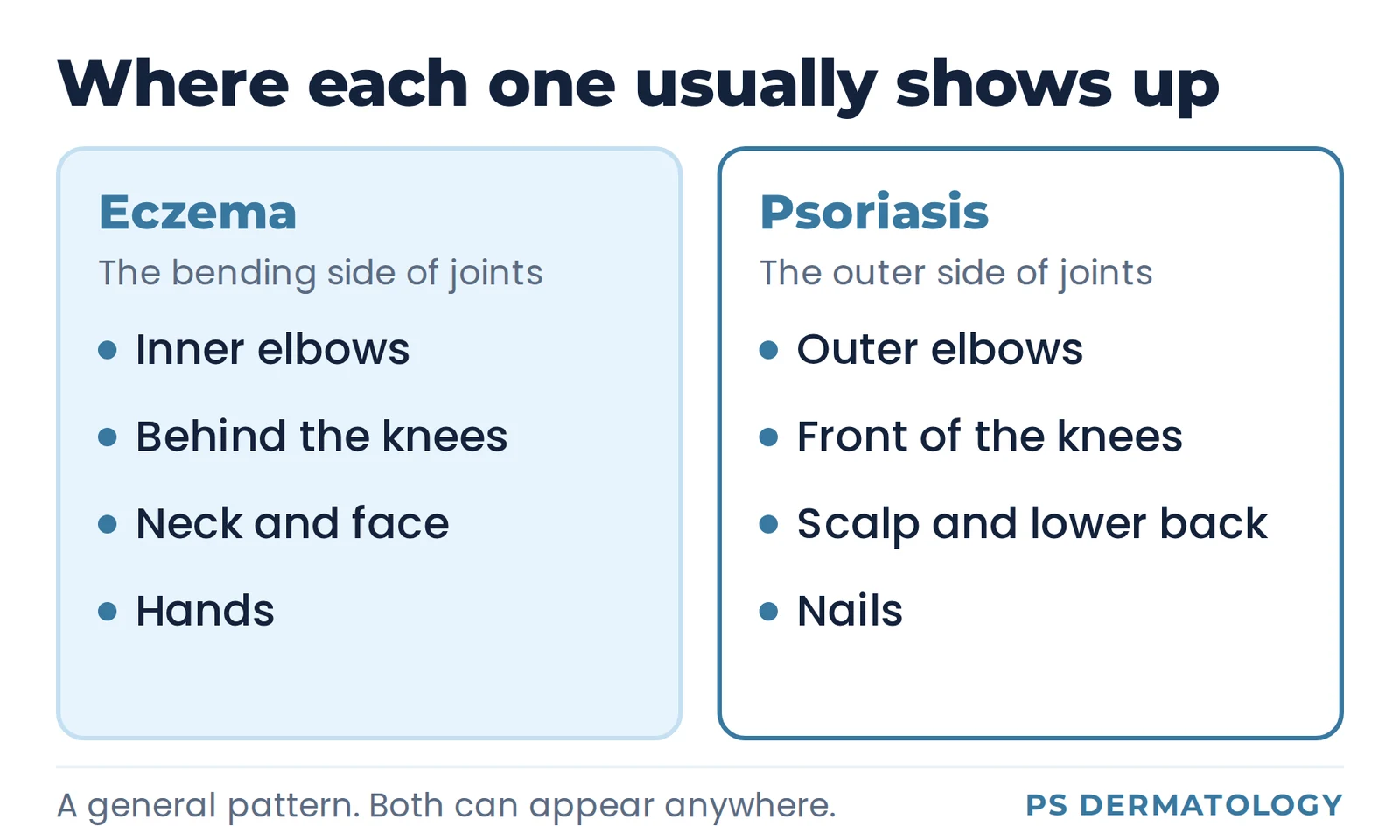
| Common spots | Inner elbows, behind the knees, neck, face, hands | Outer elbows, knees, scalp, lower back, nails |
| When it starts | Often in childhood, though it can begin in adulthood | Usually in adulthood, often with a family history |
| Other links | Asthma and hay fever in the person or family | Joint pain or stiffness (psoriatic arthritis) in some people |
Table: A general guide only. Many people do not fit neatly into one column.
Location is one of the strongest clues. Eczema tends to favor the bending side of joints, such as the inner elbow and the back of the knee. Psoriasis tends to favor the outer, extending side, such as the outside of the elbow and the front of the knee.
Nails and scalp can point toward psoriasis. Small pits in the nails, thickened nails, or well-defined scaly plaques along the hairline are more typical of psoriasis. Scalp flaking has other causes too, including seborrheic dermatitis, which is one more reason an exam helps.
What do psoriasis and eczema have in common?
Both are long-term conditions that come and go in flares. Both can be set off by dry air, stress, harsh soaps and scratching, which is why many people notice both get worse in winter. We cover the winter side of eczema in why eczema gets worse in winter.
Neither condition is contagious. You cannot catch psoriasis or eczema from another person, and you cannot pass it on by touch.
Why does it matter which one you have?
The treatment plan depends on the diagnosis.
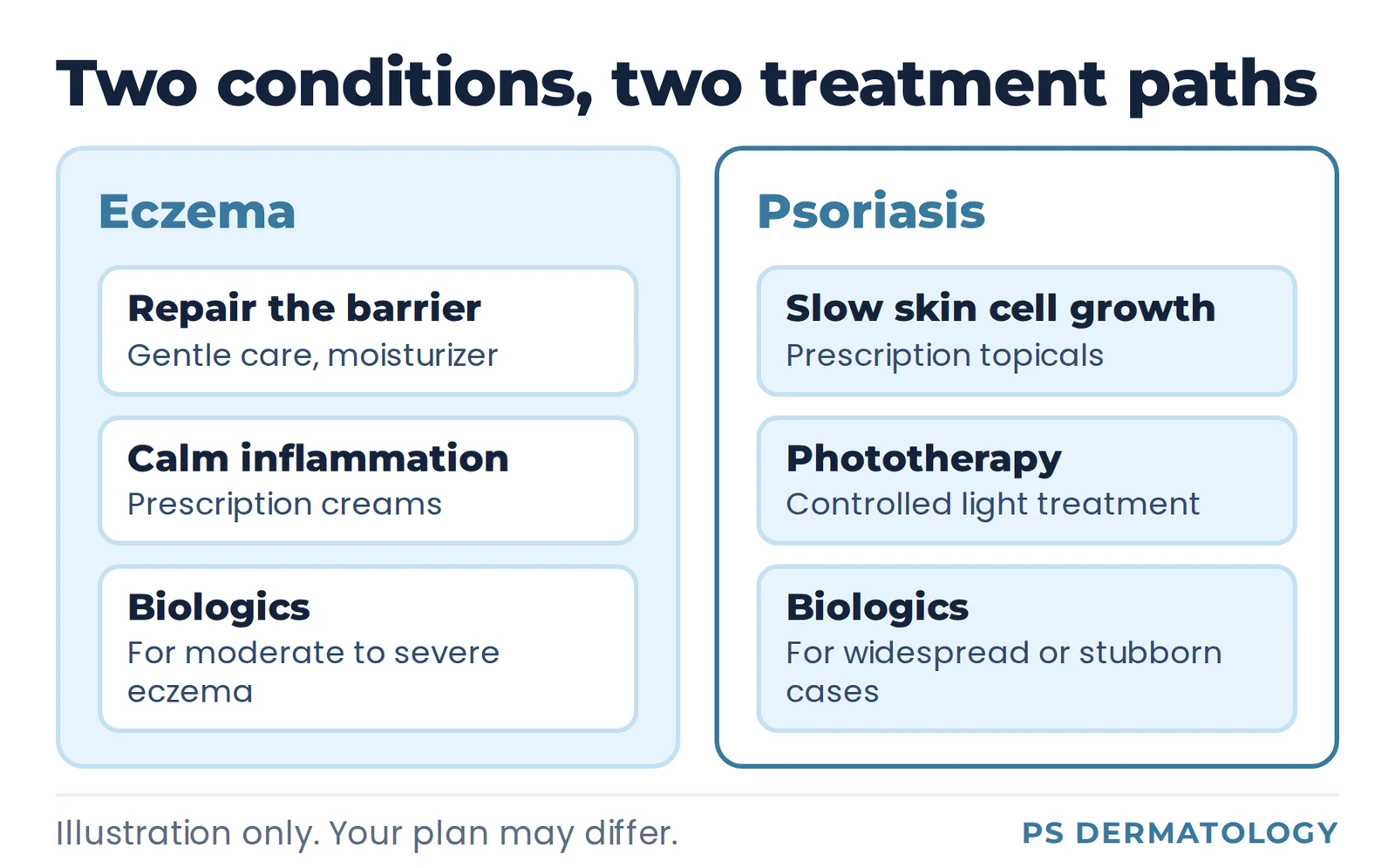
- Eczema care centers on repairing the skin barrier and calming inflammation: gentle cleansing, regular moisturizing, prescription anti-inflammatory creams, and for moderate to severe cases, targeted biologic medications.
- Psoriasis care aims to slow the overactive skin cell growth: prescription topical treatments, phototherapy, and for more widespread or stubborn cases, biologic medications that target specific parts of the immune response.
Some medications are used for both, but many of the newer biologics are approved for one condition and not the other. Treating psoriasis as eczema, or the reverse, can mean months of creams that never quite work.
How does a dermatologist tell them apart?
Most of the time, a dermatologist can tell the difference by looking closely at the skin, the scalp and the nails, and by asking about your symptoms and family history. When the picture is unclear, a small skin biopsy can confirm the diagnosis. It is a quick in-office procedure done with local numbing.
When should you see a dermatologist?
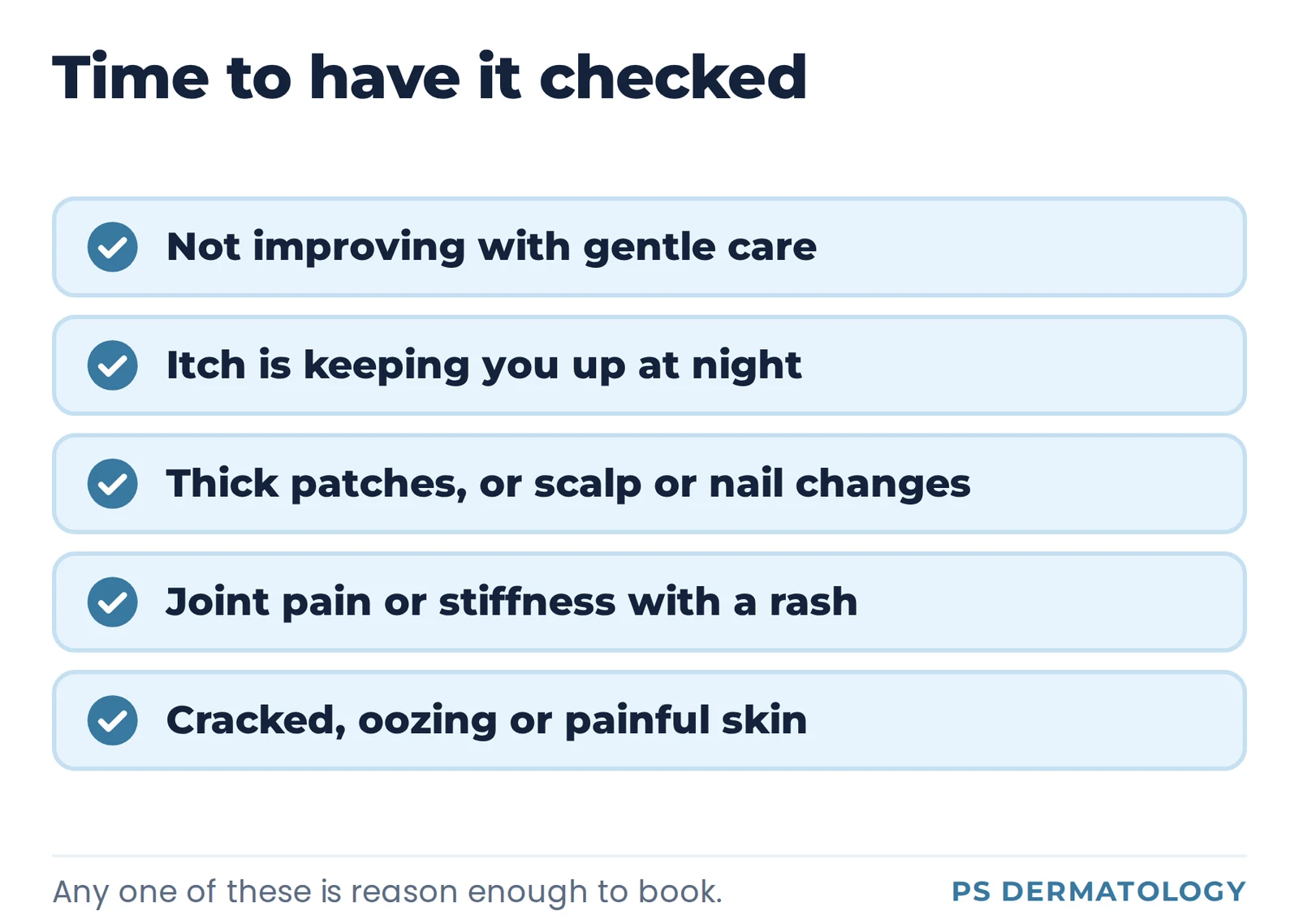
It is a good idea to book a visit if:
- the rash has not improved with gentle skin care and over-the-counter products
- itching is keeping you up at night or affecting your work or school
- patches are thick, spreading, or showing up on the scalp or nails
- you have joint pain, swelling or morning stiffness along with a skin rash
- the skin is cracked, oozing, crusted or painful, which can be a sign of infection
You can read more about how we treat each condition on our psoriasis page and our adult eczema page.
FAQ
Can you have psoriasis and eczema at the same time?
Yes, though it is uncommon. Some people have features of both, and a dermatologist may treat each area according to what it shows.
Does psoriasis always have a silvery scale?
No. Scale can be lighter on some skin tones and in skin folds, and on darker skin, plaques may look purple, gray or dark brown rather than red.
Will moisturizer help both?
Moisturizing helps the skin barrier in both conditions and is part of almost every plan, but on its own it is rarely enough to control a moderate flare of either.
Sources
If a rash keeps coming back or is not responding to what you have tried, an evaluation is the fastest way to know what it is and how to calm it.
Individual results vary.
Ready to talk with a dermatologist?
Schedule a visit with our team at PS Dermatology and Surgery in Bridgewater, NJ - serving patients throughout Central New Jersey.